So, I'm waiting like a kid at Christmas to get into my new classroom at my new school! Here's my Timehop showing how nice and decorated my room was 4 years ago, and how it looks today. (Of course, it's not the same room...)
Look at how clean and shiny it is! And look how empty it looks! It's just BEGGING me to come in and set it up!
Tomorrow's the day, so I'm spending some time cutting out some last minute pieces of lamination to hang up in the room.
I'M SO EXCITED!
Do you get that way when it's time to set up your room every summer? Or do you dread having to get up early and climb up on step ladders?
I'll post pictures as the room starts to develop... woohoo!
~Dallas
Thursday, July 23, 2015
Thursday, July 16, 2015
Why Instagram Is Good For Your Classroom
I pinned something early this morning about 5 ways that Instagram is good for your business. It reminded me of the ways I use it in the classroom! So, being the nerdy, nerdy, nerdy teacher that I am, I whipped this up to show you 5 ways that Instagram is good for your classroom! Feel free to ask me questions, and share it with other teachers, too!
To read the original post I wrote about how I started using Instagram in the classroom, click HERE.
Tuesday, July 14, 2015
Gearing Up for Interactive Notebooks
As we're gearing up to start a new school year, I'm getting ready for interactive notebooks (INBs) for my middle schoolers in ELA this year!
Today, I'm going to let you know a little bit about how I'm getting ready. There are so many blog posts out there about how to create an INB - my recommendation is to look at Erin Cobb's stuff (I'm Lovin' Lit on TpT, and you can visit her website HERE). She's amazing, and she has INB products available for ELA for 4th-8th grades.
If you're looking for math INB products, check out Jennifer Findley (find her TpT store HERE). She has math products for 3rd - 5th grade.
I do a little combination of cut-and-fold interactive items and some creative artsy designs in my notebooks. I do like the foldables, but sometimes, if we need something quick (and you know some days are like that), we take notes and I allow students to draw pictures, comics, or diagrams that help them process and understand the information.
So before my kids come in, I make INB kits. Last year, I had them in clear plastic shoebox bins with lids. This year, I'm putting them in zipper pouches. I like these because you can see in them. I purchased these at Walmart for $0.97 each. I have 14 of these, so in a class of 28, they can share a pouch for every two students.
I've included skinny markers (or do we call them "thin" in this day and age?), colored pencils, and scissors. I will include glue once I purchase some. Walmart and Target both have Crayola skinny markers for $0.97 a box. At Walmart, you can get the 12-count Crayola colored pencils for $0.97, or you can get the RoseArt brand for $0.50 a box. At Target, the 12-count Crayola colored pencils were more expensive (I don't remember the price - sorry!), but the Target brand for 12-count was $0.74. Maybe you're like me and you price shop!
I have a great Thirty-One bin that I'm going to put these in. I'm hoping I can swing by Home Depot and Lowe's to grab some paint stirrers for free so my students can use those for straight edges when needed/wanted. I'll toss those in the bin along with these kits. On days we need the kits, I'll post a note on the board, and kids can grab a kit and have a seat, getting ready for class to begin! I think the zipper pouches will be easier to grab than the plastic bins, and they take up MUCH less space.
*I actually have multiple of these bins. You can view them on the Thirty-One website HERE. I love these because they are really large, and if you buy the lid, they are stackable! I also like the fact that you can see into them. Visibility is huge in the classroom so you (and the students) can easily figure out where things go. (If you don't have a Thirty-One consultant, just let me know and I'll hook you up with mine - Kaitlin is awesome! Visit her page HERE.)
For the covers, I love to have students decorate their notebooks and make them their own! You can see mine above, and my son made this one this summer. (This is not a school INB for him - he just wanted to make a personalized notebook!) I purchased full-sheet labels off Amazon for $11.64. (HERE's the link.) You get 100 labels in the box. For ours, I printed out logos or pictures of the things we love. We colored them, cut them out, peeled off the back, and had instant customized stickers!
When the students decorate their notebooks in class, I'm going to give each student a half of the label page. They can draw, write, or decorate to their hearts' content! Then they can cut and peel too, and they will have beautiful, personalized notebooks. I really believe that if they make them specific to their interests, they take greater pride in what they put in the notebooks.
If you look closely at the picture of my INB, you can see a ribbon coming out of the bottom. It's so easy to tie a ribbon to the top of the coil, then let it be used as a bookmark for their notebooks.
So that's how I'm setting up my INBs for this school year. Do you use them? Feel free to share your tips below!
Today, I'm going to let you know a little bit about how I'm getting ready. There are so many blog posts out there about how to create an INB - my recommendation is to look at Erin Cobb's stuff (I'm Lovin' Lit on TpT, and you can visit her website HERE). She's amazing, and she has INB products available for ELA for 4th-8th grades.
If you're looking for math INB products, check out Jennifer Findley (find her TpT store HERE). She has math products for 3rd - 5th grade.
I do a little combination of cut-and-fold interactive items and some creative artsy designs in my notebooks. I do like the foldables, but sometimes, if we need something quick (and you know some days are like that), we take notes and I allow students to draw pictures, comics, or diagrams that help them process and understand the information.
So before my kids come in, I make INB kits. Last year, I had them in clear plastic shoebox bins with lids. This year, I'm putting them in zipper pouches. I like these because you can see in them. I purchased these at Walmart for $0.97 each. I have 14 of these, so in a class of 28, they can share a pouch for every two students.I've included skinny markers (or do we call them "thin" in this day and age?), colored pencils, and scissors. I will include glue once I purchase some. Walmart and Target both have Crayola skinny markers for $0.97 a box. At Walmart, you can get the 12-count Crayola colored pencils for $0.97, or you can get the RoseArt brand for $0.50 a box. At Target, the 12-count Crayola colored pencils were more expensive (I don't remember the price - sorry!), but the Target brand for 12-count was $0.74. Maybe you're like me and you price shop!
I have a great Thirty-One bin that I'm going to put these in. I'm hoping I can swing by Home Depot and Lowe's to grab some paint stirrers for free so my students can use those for straight edges when needed/wanted. I'll toss those in the bin along with these kits. On days we need the kits, I'll post a note on the board, and kids can grab a kit and have a seat, getting ready for class to begin! I think the zipper pouches will be easier to grab than the plastic bins, and they take up MUCH less space.
*I actually have multiple of these bins. You can view them on the Thirty-One website HERE. I love these because they are really large, and if you buy the lid, they are stackable! I also like the fact that you can see into them. Visibility is huge in the classroom so you (and the students) can easily figure out where things go. (If you don't have a Thirty-One consultant, just let me know and I'll hook you up with mine - Kaitlin is awesome! Visit her page HERE.)
For the covers, I love to have students decorate their notebooks and make them their own! You can see mine above, and my son made this one this summer. (This is not a school INB for him - he just wanted to make a personalized notebook!) I purchased full-sheet labels off Amazon for $11.64. (HERE's the link.) You get 100 labels in the box. For ours, I printed out logos or pictures of the things we love. We colored them, cut them out, peeled off the back, and had instant customized stickers!
When the students decorate their notebooks in class, I'm going to give each student a half of the label page. They can draw, write, or decorate to their hearts' content! Then they can cut and peel too, and they will have beautiful, personalized notebooks. I really believe that if they make them specific to their interests, they take greater pride in what they put in the notebooks.
If you look closely at the picture of my INB, you can see a ribbon coming out of the bottom. It's so easy to tie a ribbon to the top of the coil, then let it be used as a bookmark for their notebooks.
So that's how I'm setting up my INBs for this school year. Do you use them? Feel free to share your tips below!
Tuesday, July 7, 2015
A Summer of Waiting
If you read my last blog post, you know that I'm leaving 5th grade to teach middle school language arts next year! I am very excited about it, but this has definitely been a summer of waiting!
I don't know which grade I'm teaching yet. I don't know what room I'm working in. I don't know much of anything... except that I have a job! (I am very grateful for that fact, by the way!)
This time of year, I'm usually already in my classroom setting up. (Teachers go back in our district on July 30th this year.) Since I can't do that, I've been doing some projects at home and hanging out with my ten-year-old son instead!
Right now I'm working on decluttering... oh my word, do you ever look around your house and think WHERE DID ALL OF THIS COME FROM?! That's kind of how I'm feeling this summer, so I'm using my downtime to get rid of things I don't love or use. That can be a pretty big undertaking!
I'm going to share some of my declutter plans for the rest of this week. This is the kind of stuff we don't make time for once the school year starts. If you're anything like me, you're going ninety miles a minute once you set foot back in your classroom!
Bathroom
Clean out your medicine cabinet! (For me, it's a drawer.) Get rid of any medications that are old or expired. Do you have big boxes of tablets, like children's medicine or OTC sinus meds, and they only have a couple of tablets left in there? Get rid of that big box. I have tons of big boxes of children's Tylenol and Benadryl, but the boxes aren't full anymore. By getting rid of the big boxes, I have a little more space, plus I know to stock back up on those things. You'll definitely need lots of cold and headache medicines once school starts back, so if you spend a little time decluttering, you'll be able to purchase those important items before you really need them (and are likely too sick to go out and get them!).
Declutter your makeup drawer. Maybe you're like me and have about 7 or 8 similar shades of lipstick but only stick to one or two signature colors. Repeat after me: IF I DON'T LOVE IT OR USE IT, IT'S OKAY TO THROW IT OUT. I used to have the hardest time doing that. I'd say to myself, "Oh, but I spent money on that..." Now you're just taking up space - get rid of it!
Bedroom
Sort out everything in your dresser drawers. I mean everything. This terrifies me. I've moved to the dreaded land of plastic bins all of my closet to contain everything from scarves to extra pajama sets. IT'S GOT TO STOP. I am pretty ruthless when it comes to getting rid of clothes I no longer wear. (I went through my hanging clothes last week and took two big bags to Goodwill today.) Now it's time to tackle the drawers. I think this is so hard for me because I have so many drawers and so much foldable stuff. I have to conquer this!
Closet time. I've done this already - but if you haven't worn it during this season, get rid of it. You're a creature of habit, and you probably won't wear it in the future. Stop lying to yourself. I know. I did it for years.
Declutter that nightstand. Why is mine so full of crap?! I think I just need to chuck it all in a garbage bag. I'm fairly certain I haven't used the drawers in months.
Those are the things I plan to tackle this week. Next week will *hopefully* be my last week not knowing what I'm doing for school next year, so it will be my last ditch week to declutter. Here's what I'll probably tackle then:
*Kitchen junk drawer (God help us all)
*Linen closet (I feel like I do this all the time and it NEVER EVER gets better)
*Laundry room (It's truly a disaster. I don't want to. But I really should.)
Do you get the urge to clean out and declutter during the summer? If you have any advice or tips, I'd love to hear them!
I don't know which grade I'm teaching yet. I don't know what room I'm working in. I don't know much of anything... except that I have a job! (I am very grateful for that fact, by the way!)
This time of year, I'm usually already in my classroom setting up. (Teachers go back in our district on July 30th this year.) Since I can't do that, I've been doing some projects at home and hanging out with my ten-year-old son instead!
Right now I'm working on decluttering... oh my word, do you ever look around your house and think WHERE DID ALL OF THIS COME FROM?! That's kind of how I'm feeling this summer, so I'm using my downtime to get rid of things I don't love or use. That can be a pretty big undertaking!
I'm going to share some of my declutter plans for the rest of this week. This is the kind of stuff we don't make time for once the school year starts. If you're anything like me, you're going ninety miles a minute once you set foot back in your classroom!
Bathroom
Clean out your medicine cabinet! (For me, it's a drawer.) Get rid of any medications that are old or expired. Do you have big boxes of tablets, like children's medicine or OTC sinus meds, and they only have a couple of tablets left in there? Get rid of that big box. I have tons of big boxes of children's Tylenol and Benadryl, but the boxes aren't full anymore. By getting rid of the big boxes, I have a little more space, plus I know to stock back up on those things. You'll definitely need lots of cold and headache medicines once school starts back, so if you spend a little time decluttering, you'll be able to purchase those important items before you really need them (and are likely too sick to go out and get them!).
Declutter your makeup drawer. Maybe you're like me and have about 7 or 8 similar shades of lipstick but only stick to one or two signature colors. Repeat after me: IF I DON'T LOVE IT OR USE IT, IT'S OKAY TO THROW IT OUT. I used to have the hardest time doing that. I'd say to myself, "Oh, but I spent money on that..." Now you're just taking up space - get rid of it!
Bedroom
Sort out everything in your dresser drawers. I mean everything. This terrifies me. I've moved to the dreaded land of plastic bins all of my closet to contain everything from scarves to extra pajama sets. IT'S GOT TO STOP. I am pretty ruthless when it comes to getting rid of clothes I no longer wear. (I went through my hanging clothes last week and took two big bags to Goodwill today.) Now it's time to tackle the drawers. I think this is so hard for me because I have so many drawers and so much foldable stuff. I have to conquer this!
Closet time. I've done this already - but if you haven't worn it during this season, get rid of it. You're a creature of habit, and you probably won't wear it in the future. Stop lying to yourself. I know. I did it for years.
Declutter that nightstand. Why is mine so full of crap?! I think I just need to chuck it all in a garbage bag. I'm fairly certain I haven't used the drawers in months.
Those are the things I plan to tackle this week. Next week will *hopefully* be my last week not knowing what I'm doing for school next year, so it will be my last ditch week to declutter. Here's what I'll probably tackle then:
*Kitchen junk drawer (God help us all)
*Linen closet (I feel like I do this all the time and it NEVER EVER gets better)
*Laundry room (It's truly a disaster. I don't want to. But I really should.)
Do you get the urge to clean out and declutter during the summer? If you have any advice or tips, I'd love to hear them!
Thursday, July 2, 2015
Moving to Middle School
I fully realize that I haven't blogged since October 2014. HOW ON EARTH do all you other bloggers balance teaching, living, AND blogging?! I am in awe of you all!
I have contemplated committing myself to one day a week to blog, but then real life pops up, and then I think about blogging, but then I say to myself, "I have nothing interesting to write about!" But I don't let my students take that attitude when it comes to writing...
So here I am. I'm going to blog more often. Hopefully. Will you hold me to it?
At any rate, here's my first blog post of 2015!
Big announcement... I'm moving to Middle School!
I've spent the entire 8 years of my career at the same elementary school. I taught 3rd grade the first two years and 5th grade for the last six. I have L-O-V-E-D teaching elementary, I loved the people I worked with, and I loved my school. So why the move?
Have you ever just felt a deep yearning in your heart for change? A desire for something different? A want for challenge?
Yup. That was me. I really found myself loving literature and teaching writing, and I felt in the deepest parts of my soul that I wanted to do that - and only that - all day long. I wouldn't have that opportunity at the elementary level, so I knew I had to move up to either middle school or high school. High school scares the bejeebers out of me, so middle school it was!
I took the GACE for middle grades and interviewed for an ELA position, and voila! Here I am - about to embark on a journey as a 7th grade ELA teacher!
Do any of you use Timehop? According to the app, I have noticed in the last couple of days that around this time in summers past, I have been working on classroom decor, new classroom ideas, cutesy organizational tools, etc. This summer is a bit different.
I don't know which classroom I'm going to be in yet. I don't know which exact classes I'm teaching. I don't really know a whole lot! For the first time ever, I'm having a hard time finding things to do this summer.
I do know that middle schoolers aren't going to want any of the cutesy-wutesy stuff of elementary school. I am, however, a firm believer in a classroom being a comfortable, beautiful place to be. I've switched my organizational tools from my sweet primary colors to more grown-up designs in red, black, gray, and white. But for other things... it's hard to plan when I haven't seen my classroom yet!
Even though I am waiting on the details, I am thrilled to become a middle school teacher. The teachers are so welcoming and fun at my new school. I am sarcastic and love to be a little crazy, so I am hopeful I will be a good fit with 7th graders.
For those of you who teach middle school, do you have any advice for me? It's a kind of surreal going from knowing the routine to embarking on something new. Any words of wisdom would be welcome!
Til next time,
I have contemplated committing myself to one day a week to blog, but then real life pops up, and then I think about blogging, but then I say to myself, "I have nothing interesting to write about!" But I don't let my students take that attitude when it comes to writing...
So here I am. I'm going to blog more often. Hopefully. Will you hold me to it?
At any rate, here's my first blog post of 2015!
Big announcement... I'm moving to Middle School!
I've spent the entire 8 years of my career at the same elementary school. I taught 3rd grade the first two years and 5th grade for the last six. I have L-O-V-E-D teaching elementary, I loved the people I worked with, and I loved my school. So why the move?
Have you ever just felt a deep yearning in your heart for change? A desire for something different? A want for challenge?
Yup. That was me. I really found myself loving literature and teaching writing, and I felt in the deepest parts of my soul that I wanted to do that - and only that - all day long. I wouldn't have that opportunity at the elementary level, so I knew I had to move up to either middle school or high school. High school scares the bejeebers out of me, so middle school it was!
I took the GACE for middle grades and interviewed for an ELA position, and voila! Here I am - about to embark on a journey as a 7th grade ELA teacher!
Do any of you use Timehop? According to the app, I have noticed in the last couple of days that around this time in summers past, I have been working on classroom decor, new classroom ideas, cutesy organizational tools, etc. This summer is a bit different.
I don't know which classroom I'm going to be in yet. I don't know which exact classes I'm teaching. I don't really know a whole lot! For the first time ever, I'm having a hard time finding things to do this summer.
I do know that middle schoolers aren't going to want any of the cutesy-wutesy stuff of elementary school. I am, however, a firm believer in a classroom being a comfortable, beautiful place to be. I've switched my organizational tools from my sweet primary colors to more grown-up designs in red, black, gray, and white. But for other things... it's hard to plan when I haven't seen my classroom yet!
Even though I am waiting on the details, I am thrilled to become a middle school teacher. The teachers are so welcoming and fun at my new school. I am sarcastic and love to be a little crazy, so I am hopeful I will be a good fit with 7th graders.
For those of you who teach middle school, do you have any advice for me? It's a kind of surreal going from knowing the routine to embarking on something new. Any words of wisdom would be welcome!
Til next time,
Saturday, October 18, 2014
Why I Hope I Never Want to Give up Teaching
(I know I haven't posted in a while - busy doing this thing called teaching - but I felt like I needed to post this. Let me preface this post by saying these are MY views, not the views of my administration, fellow teachers, or school system. And - I love my administrators. They are awesome people. Now, without further ado...)
So I’ve seen this post floating around the
Internet, and honestly, I’ve refused to click on it in the past to even read
what it had to say. The article is titled, “Why I Want to Give Up Teaching.”
After seeing six or seven teaching colleagues post the same article, I finally
gave in and read it. This blog post is my opinion, and it’s the opposite… ”Why
I Hope I Never Want to Give Up Teaching.”
To Mrs. Natale, the teacher who wrote the
article, I completely understand your frustrations. This is only my eighth year
teaching, but I have been through similar situations. We started off in Georgia
with the QCC standards, then moved to the GPS, and now we’re part of the CCGPS
– Common Core Georgia Performance Standards. I’ve seen a shift in the field
from using tests to see how kids are doing to now using tests to measure my own
effectiveness. No, I’m not a fan.
I’m with you. I don’t think it’s fair that my
performance as an educator will be tied to whether or not one of my precious
students passes a fifth grade reading test when she is reading on a first grade
level. (We’ve been working on phonics during our lunch times together; b-a-t,
stretch out each sound, tap it out, put them together… good job, that’s “bat!”
Now let’s try another…) I don’t think it’s fair to assess how effective I am in
my classroom when I have students who break down into tears because they miss
their dad who’s passed away, or a loved one has gone to jail, or their mother
is too busy working three jobs to help them with their homework. I refuse to
say, “Buck up, buttercup, you’ve got to work harder on this long division.”
Sometimes, I put the math away and bring out the hugs and a piece of bubble gum
instead. (Hopefully an administrator won’t pop in for a walk-through during one
of those moments, or I’ll have documentation that I’m ineffective.)
HOWEVER, these are the exact reasons I refuse
to quit teaching. My students need an educator who sees all these crazy shifts
in education but still stands as a rock for her students. When times in
education are changing – and when times in my students’ lives are changing –
they need someone strong to whom they can cling. They need a rock in the storm.
They need a shelter to help them weather all the winds of change that blow
their way. And I honestly, truly, completely believe that God has created me to
be that safe place.
No matter how tough educational mandates may
be, they are likely harder on my students. I cannot allow testing requirements,
TEM (teacher effectiveness measure) scores, or changes in standards to sway me
from my goal. And my goal is to teach children. I don’t teach standards. I
don’t teach to tests. I don’t even teach novels or math concepts. No, this lady
right here teaches CHILDREN.
I know the pressure – it stares me in the
face every day. I have to prepare my children for the fifth grade end-of-year
test. I also have to prepare my students for middle school. Those pressures do
weigh heavily on me. BUT I cannot change course. I cannot let it affect me. I
cannot let the pressures of teaching make me less effective. And I don’t mean
“effective” by my administration’s standards (though I do hope they think I do
a good job). I mean effective by my students’ standards.
I saw a former student at the store today,
and as soon as we made eye contact, a huge grin came upon his face. I taught
him 6 years ago, but he immediately began to tell me how fifth grade was one of
the best years of his life. His mom recognized me as well, and we were
instantly transported back to the days when her son was just a scrawny
ten-year-old boy in my class. Now he’s a tall, beefy ball player. I was honored
that he remembered me, humbled by his mama’s sweet words to me, and blessed by
our conversation in the checkout line. HE, the countless children I’ve taught
in the past, and my students today are my fuel; when my energy tank seems low,
they keep me going.
Yes, education is a crazy field. But to all
my brothers and sisters in this career field, it’s probably not going to get
better. My friends who have taught for twenty years or more tell me that
education is like a pendulum. It swings back and forth. What was all new twenty
years ago will swing back into popularity. What was all the rage in education
10 years ago has gone out… but just wait, we’ll see it again with a fancy new
acronym. We can’t let change keep us from doing the jobs that our children NEED
us to do.
Mrs. Natale, you seem like a passionate lady.
Please don’t quit teaching. Your children need you. I think I’m a pretty good
teacher, and I also think my children need me. America’s children need strong
men and women to weather the craziness we call “teaching” and show up ready to
defy all odds on a daily basis. Because we all know that the odds won’t always
be in our favor, but if we can sustain our passion, we CAN defy those odds. I
may be a little biased, but I think teachers are heroes. To all of my teacher
friends who have felt this way in the past, please don’t quit. You never know
which child sitting in your classroom is desperate for a hero. So suit up,
friends. Your cape is calling.
Friday, August 1, 2014
Classroom Tour 2014-2015
Well, my friends, I've decided to go with a Jazz theme for the year! In 5th grade social studies in GA, one of our units involves the Harlem Renaissance and the 1920s, so having a jazz theme fits in perfectly! Take a look around my room - I just finished it today! (Our kids start on Thursday.)
So that's a quick tour of my room. Have you set your classroom up yet? Posted pictures to your blog? Leave a link in the comments below! I love looking at room decor!
| This is the first thing parents and students will see when they walk through my door. Student tables are labeled with famous Americans we'll study throughout our social studies year! |
![]() |
| Speaking of door, this is on the front of my classroom door! I love the positive message it sends to parents and students. |
| Some fun colorful character signs I found on Pinterest! (Find the signs HERE.) The blue buckets are for kids who brought their lunches - this is the storage spot. |
| We are going to have expectations, not rules, in my class this year! Be nice. Work hard. Let the teacher teach! I am also using the 4 stages of behavior from Discipline without Stress, Punishment, or Rewards. Those are listed on this wall as well. In this same spot, I have crayons divided up by colors in the red drawer container (warm colors, cool colors, and neutrals - trying to incorporate some art terms there) and my pencil drawers with the chevron front. That has a place for erasers, dull pencils, and sharpened pencils. Something new I'm trying this year is the crate with the Ketchup & Pickle folders. This is a really great idea I've adapted from the way I used to use Ketchup & Pickle in my classroom. Find out more about how it works in my post about it HERE. |
| Student cubbies with African artifacts on top (from my mission trip two summers ago) |
![]() |
| This is just half of my class library, but I added the red curtain above the Promethean board to "jazz" the room up a little! I can open it all the way when the board is in use. |
| I just love these character posters from Creative Teaching Press! |
![]() |
| I love the black on the walls with the colorful accents around the room. |
![]() |
| I have a folder ready with all the students' open house forms that need to be completed and returned. |
| Each student gets a special treat for open house - a bag of white cheddar popcorn (yummy and healthy!) that says, "Thanks for POPPING by! Love, Mrs. Thompson" |
| The room... with my fancy rolling podium! I love that! |
Wednesday, July 23, 2014
How We Do Service Learning
I've had some inquiries about how our class (and now our entire grade level) does service learning. I consider myself very blessed to work with a grade level team filled with women who are also passionate about serving others! The entire 5th grade at our school participates in service learning. The joy of serving others has spread, and our second grade team partners with us as well! The focus on service learning makes teaching even more enjoyable, I believe.
So, why teach students to serve other people? One of my major beliefs as an educator is that I need to expose my students to the needs of others both in our local community and around the world. I believe that a focus on service learning teaches character and problem-solving with a real live audience! That is a true motivator.
In order to make service-learning successful, students need to drive the majority of it. If there's no student buy-in, it's less meaningful and you are more apt to have behavior issues during the project. When the kids are working on something they believe in, they'll all be engaged and want to produce their very best work to serve whomever they are serving.
The three projects we have done in the past are The 9/11 Care Package Project, the Partnership with The Guest House, and The Sandwich Project.
Two of the service learning ideas started out as my brainchild. I introduced them as, "Hey, do y'all want to do this?" I took the "excitement" temperature of my class, and if it was high, I asked the kids to decide how they wanted to proceed. This was how the 9/11 Care Package Project and Partnership with The Guest House began. The kids would share their ideas at their tables, then I would appoint a "project manager" to take ideas on the board and lead the class discussion. It's totally okay for a teacher to suggest a service project idea... but it's very important to let the students run with it!
The Sandwich Project (detailed at the bottom of the page) was completely the idea of my students. It was a beautiful thing to behold! Of course, every year after that, I had to reintroduce it to my students and see if they still wanted to run with it. Each year when we make sandwiches, the totals are announced to the whole school over the intercom, so the kids generally come to 5th grade excited about participating in this project. 2nd grade also participates in making sandwiches with us every year, so most of the kids have already done it once and look forward to doing it again!
Without further ado, here are details about the 3 major projects we focused on last year!
9/11 Care Package Project
In honor of 9/11, our entire 5th grade decided to sponsor soldiers and send them care packages! As a grade level, we sent care packages to 12 soldiers. All of the soldiers we chose were people with whom we had a personal connection. The kids wrote letters of thanks for the soldiers' service, drew patriotic pictures, and packed some essentials for the soldiers.
Once boxes were packed, students had to fill out the USPS form detailing what was in the box, how many of each item, etc. This service learning project incorporated writing, art, and math. (I would argue that it included engineering, too, considering they had to pack, unpack, and repack the boxes a few times to make everything fit better!)
We got lots of suggestions from many different people (all of whom knew a lot about the needs of military folks) about what to include in our care packages.
Interested in doing this project? Some of the items we included:
The Guest House recently moved just up the street from our school, so it is within walking distance! Hooray! We did 3 events there this year. On Halloween, we walked up in costumes and read scary stories that the students had written themselves. They happened to have a man-and-wife duo who came to play the guitar and sing that day, so our kids got to dance and sing with the seniors. It was so much fun!
For Christmas, my students all made cards for their friends at The Guest House. I took 4 of the students with me after school to go deliver the cards and spread some Christmas cheer.
At the end of the year, the students had planned a Civil Rights Concert and sang some songs they had learned during that unit. They also made posters about famous Americans during this time period and presented those as well.
When you're working with seniors, it doesn't really matter that you do anything fancy! They just want someone to come spend time with them. I know that when I was in 4th grade, we visisted a nursing home and played cards and bingo with them. We will be doing some low-key things like this next year as well.
So far, only my class has visited The Guest House, but the rest of the grade level is excited to be joining this project in the upcoming school year!
Interested in doing a similar project? Contact a local nursing home or senior center to see what their needs are. Our seniors always love hearing kids talk or sing, and many of them love to share their life stories with kids. There's always a need to be filled! If you can't walk somewhere, talk to someone at your school about getting permission for a special field trip. There's something about service projects that defintely makes them harder to turn down!
The Sandwich Project
This is our BIGGEST project. It all started in September 2010, and it began with a book... Something Beautiful, written by Sharon Dennis Wyeth and illustrated by Chris Soentpiet. This has been my service labor of love, and I am so pleased with how big this project has become!
Instead of rewriting a post I have already published on my class website, I am going to copy what I have written on my service learning page and paste it below. To see even more pictures, visit that page HERE.
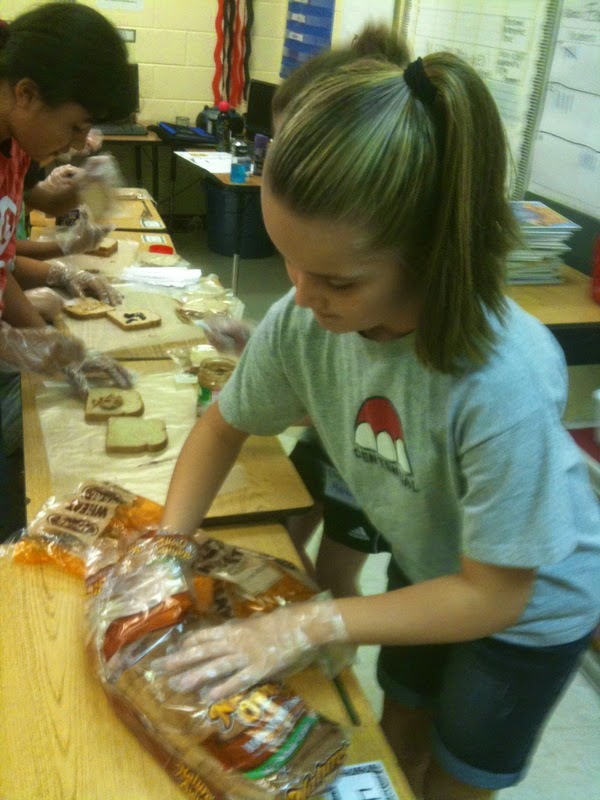
In September of 2010, I decided to read one of my favorite picture books to my fifth grade students. Little did I know it would be the start of something amazing...
I like to use picture books even though I teach fifth grade. To leave these books out of my reading class would be denying my students exposure to some wonderful literature. As an added bonus, picture books can be read, start to finish, in one class period. These books also often have rich details about character and setting, and we can reach the resolution of a conflict quickly.
This one particular school day, I was going to read Something Beautiful, written by Sharon Dennis Wyeth and illustrated by Chris K. Soentpiet. I met the illustrator at a reading conference, and he generously autographed my copy of this beloved book. This is a beautiful story, and I have loved it for a long time because of that. However, I have a weakness for autographs, so that made this book even better in my eyes!
In the book, the main character, a little girl in an inner-city neighborhood, goes on a search for “something beautiful.” She sees the word “DIE” graffitied on her door, she passes a homeless woman wrapped in plastic outside of her cardboard shelter, and broken bottles in the alley. She polls her friends, neighbors, and family to find something beautiful, and finds that beauty can be found everywhere you look: in a baby’s laugh, in the sound of beads in a girl’s hair, in the fresh fruit at a produce stand. She decides to clean up the ugliness around her. She says, “I feel powerful.” At the end of the book, she asks her mom if she has anything beautiful. This is where, even though I read this every year to my students, I begin to cry. The mom tells her, “Of course. I have you.”
This book, as I said, is a lovely story with stunning illustrations. I had planned, in my opinion, a quality standards-based lesson about the setting influencing the conflict in the story. My students, however, had a different plan in mind.
As always, we discussed what from the book stood out to us. Immediately, one of the students said he was very bothered by the part with the homeless woman, and he said he was sad for her. Other students began to agree aloud. Another student mentioned that she had seen the article in the local newspaper about homeless people in our own community who were living under a bridge and about how tough life was for them.
In a matter of minutes, we were off the track I had planned. I like to redirect the students when they start to lose focus on the standard I’m teaching, but something inside of me said to let them keep going. Deep down, I knew this was a teachable moment I couldn’t let slip through my fingers.
So, we kept talking about the homeless situation in our hometown. What can we do about it? I remember, with a smile, that the students wanted to do a bake sale and buy houses for the homeless. What big dreams! I told them, however, that I didn’t think we needed to throw money at the problem; instead, we needed to use our hearts and our hands.
I gave them homework that night - to go home and think about what we could physically do that would show love and compassion for the homeless in Gainesville.
The next day, we had another discussion about our newest endeavor. We decided that we could make sandwiches for the homeless, especially since so many of the students were worried about them being hungry. We called this endeavor “The Sandwich Project.”
I asked the students if they’d like to make sandwiches the next week, and they all shouted, “No! Let’s do it now!” I told the children I’d email their parents asking them to send in supplies for the following Friday, but that wasn’t fast enough for these kids. I then told them that their parents would not be happy with me if I demanded supplies immediately. Unfortunately, even though I have a weakness for autographs, I have an even bigger weakness for puppy dog eyes. With 25 pairs of puppy dog eyes breaking down my attempt at a steely exterior, I gave in and sent an email to all of my students’ parents, describing what had happened and what the kids wanted to do about it.
Imagine my surprise, when in just a few minutes, I had several email responses from the parents, saying, “I’ll bring bread,” or “I’ll send in some peanut butter!” The kids were ecstatic, and truthfully, I was too.
The next day, we spent an hour making 25 lunches for the homeless under the bridge. Some students made sandwiches, other students bagged the sandwiches up; some decorated brown bags for the lunches, some packed pretzels into baggies, and some added cookies. We completed the sack lunches with napkins and mints, and I sent them off with a local ministry contact who visits the bridge.
After we completed the first ever sandwich-making-day for The Sandwich Project, I asked the students to write me a letter to reflect on the experience. Never before have I cried upon reading student writings like I did that day. Students wrote, “I feel powerful.” (They remembered, from the book.) Some wrote that they now understood what it meant when people say that one person can make a difference. They wanted to keep doing it, and they wanted to do even more.
We decided to make sandwiches once a month. Our first attempt took us an hour to make 25 lunches. We finished the year making nearly 100 lunches in an hour. I guess you could say we perfected the technique!
Parents were our lifesavers - they sent in all the supplies to make this possible. Without 100% parent support, The Sandwich Project might have only been a one-time thing, if even that. I owe them a debt of gratitude.
Students never lost their enthusiasm for making lunches. The inspirational messages that decorated the bags were heartfelt. The students had to work extra hard during sandwich-making weeks; I never gave them less work just because we spent a class period making lunches. They knew they had to work harder in order to do it, but that never stopped them from making sure we took the time to help others who are less fortunate.
I heard from some of the parents that it had become a dinnertime topic in their families, and that they were looking into other ways to help the needy in our community as a family. I hope they continue to be inspired because of The Sandwich Project. It’s been something like tossing a pebble into a quiet pond; the goodness is rippling outwards. It’s been a beautiful thing to witness.
By the end of the year, we fed the homeless with over 200 lunches. Wow! Just thinking about makes me smile. I have been blessed to teach such generous students. Even if they chose to throw my lesson plans out the window. And I’m glad they did.
UPDATE: June 2014
The entire 5th grade at Centennial has worked on this project together for a few years now. Once a year, each 5th grade class partners with a 2nd grade class to make lunches. It has turned into a very special project, indeed!
Interested in doing a similar project? Churches are often a great contact for working with those in need. We worked with a ministry called Under the Bridge and are now branching out to work with a local church who opens their doors to the homeless 3 days a week for food and clothing. (By the way, just because a church is your contact doesn't necessarily make it a religious project.)
So that's how my class does service learning! If you have any questions, feel free to ask me! Does your class do service learning? Share what you do in the comments below!
So, why teach students to serve other people? One of my major beliefs as an educator is that I need to expose my students to the needs of others both in our local community and around the world. I believe that a focus on service learning teaches character and problem-solving with a real live audience! That is a true motivator.
In order to make service-learning successful, students need to drive the majority of it. If there's no student buy-in, it's less meaningful and you are more apt to have behavior issues during the project. When the kids are working on something they believe in, they'll all be engaged and want to produce their very best work to serve whomever they are serving.
The three projects we have done in the past are The 9/11 Care Package Project, the Partnership with The Guest House, and The Sandwich Project.
Two of the service learning ideas started out as my brainchild. I introduced them as, "Hey, do y'all want to do this?" I took the "excitement" temperature of my class, and if it was high, I asked the kids to decide how they wanted to proceed. This was how the 9/11 Care Package Project and Partnership with The Guest House began. The kids would share their ideas at their tables, then I would appoint a "project manager" to take ideas on the board and lead the class discussion. It's totally okay for a teacher to suggest a service project idea... but it's very important to let the students run with it!
The Sandwich Project (detailed at the bottom of the page) was completely the idea of my students. It was a beautiful thing to behold! Of course, every year after that, I had to reintroduce it to my students and see if they still wanted to run with it. Each year when we make sandwiches, the totals are announced to the whole school over the intercom, so the kids generally come to 5th grade excited about participating in this project. 2nd grade also participates in making sandwiches with us every year, so most of the kids have already done it once and look forward to doing it again!
Without further ado, here are details about the 3 major projects we focused on last year!
9/11 Care Package Project
In honor of 9/11, our entire 5th grade decided to sponsor soldiers and send them care packages! As a grade level, we sent care packages to 12 soldiers. All of the soldiers we chose were people with whom we had a personal connection. The kids wrote letters of thanks for the soldiers' service, drew patriotic pictures, and packed some essentials for the soldiers.
Once boxes were packed, students had to fill out the USPS form detailing what was in the box, how many of each item, etc. This service learning project incorporated writing, art, and math. (I would argue that it included engineering, too, considering they had to pack, unpack, and repack the boxes a few times to make everything fit better!)
We got lots of suggestions from many different people (all of whom knew a lot about the needs of military folks) about what to include in our care packages.
Interested in doing this project? Some of the items we included:
- baby wipes (sometimes the only way they have to wash up depending on the area!)
- turkey jerky (stay away from pork as it is not allowed in some middle eastern countries)
- toothpaste, mouthwash, floss, toothbrushes, etc.
- deodorant, bar soap, lotion
- cookies, fig newtons
- playing cards
I forget how much it costs to ship these boxes, but you could drop in your local post office to inquire.
Partnership with The Guest House
The Guest House is a local day facility for senior citizens who need some care and supervision during the day while their family members are at work, running errands, etc. They have anywhere between 8-18 people there at a time. The Guest House has full-time nursing care on site as well as several wonderful staff members.The Guest House recently moved just up the street from our school, so it is within walking distance! Hooray! We did 3 events there this year. On Halloween, we walked up in costumes and read scary stories that the students had written themselves. They happened to have a man-and-wife duo who came to play the guitar and sing that day, so our kids got to dance and sing with the seniors. It was so much fun!
For Christmas, my students all made cards for their friends at The Guest House. I took 4 of the students with me after school to go deliver the cards and spread some Christmas cheer.
At the end of the year, the students had planned a Civil Rights Concert and sang some songs they had learned during that unit. They also made posters about famous Americans during this time period and presented those as well.
When you're working with seniors, it doesn't really matter that you do anything fancy! They just want someone to come spend time with them. I know that when I was in 4th grade, we visisted a nursing home and played cards and bingo with them. We will be doing some low-key things like this next year as well.
So far, only my class has visited The Guest House, but the rest of the grade level is excited to be joining this project in the upcoming school year!
Interested in doing a similar project? Contact a local nursing home or senior center to see what their needs are. Our seniors always love hearing kids talk or sing, and many of them love to share their life stories with kids. There's always a need to be filled! If you can't walk somewhere, talk to someone at your school about getting permission for a special field trip. There's something about service projects that defintely makes them harder to turn down!
The Sandwich Project
This is our BIGGEST project. It all started in September 2010, and it began with a book... Something Beautiful, written by Sharon Dennis Wyeth and illustrated by Chris Soentpiet. This has been my service labor of love, and I am so pleased with how big this project has become!
Instead of rewriting a post I have already published on my class website, I am going to copy what I have written on my service learning page and paste it below. To see even more pictures, visit that page HERE.
In September of 2010, I decided to read one of my favorite picture books to my fifth grade students. Little did I know it would be the start of something amazing...I like to use picture books even though I teach fifth grade. To leave these books out of my reading class would be denying my students exposure to some wonderful literature. As an added bonus, picture books can be read, start to finish, in one class period. These books also often have rich details about character and setting, and we can reach the resolution of a conflict quickly.
This one particular school day, I was going to read Something Beautiful, written by Sharon Dennis Wyeth and illustrated by Chris K. Soentpiet. I met the illustrator at a reading conference, and he generously autographed my copy of this beloved book. This is a beautiful story, and I have loved it for a long time because of that. However, I have a weakness for autographs, so that made this book even better in my eyes!
In the book, the main character, a little girl in an inner-city neighborhood, goes on a search for “something beautiful.” She sees the word “DIE” graffitied on her door, she passes a homeless woman wrapped in plastic outside of her cardboard shelter, and broken bottles in the alley. She polls her friends, neighbors, and family to find something beautiful, and finds that beauty can be found everywhere you look: in a baby’s laugh, in the sound of beads in a girl’s hair, in the fresh fruit at a produce stand. She decides to clean up the ugliness around her. She says, “I feel powerful.” At the end of the book, she asks her mom if she has anything beautiful. This is where, even though I read this every year to my students, I begin to cry. The mom tells her, “Of course. I have you.”
This book, as I said, is a lovely story with stunning illustrations. I had planned, in my opinion, a quality standards-based lesson about the setting influencing the conflict in the story. My students, however, had a different plan in mind.
As always, we discussed what from the book stood out to us. Immediately, one of the students said he was very bothered by the part with the homeless woman, and he said he was sad for her. Other students began to agree aloud. Another student mentioned that she had seen the article in the local newspaper about homeless people in our own community who were living under a bridge and about how tough life was for them.
In a matter of minutes, we were off the track I had planned. I like to redirect the students when they start to lose focus on the standard I’m teaching, but something inside of me said to let them keep going. Deep down, I knew this was a teachable moment I couldn’t let slip through my fingers.
So, we kept talking about the homeless situation in our hometown. What can we do about it? I remember, with a smile, that the students wanted to do a bake sale and buy houses for the homeless. What big dreams! I told them, however, that I didn’t think we needed to throw money at the problem; instead, we needed to use our hearts and our hands.
I gave them homework that night - to go home and think about what we could physically do that would show love and compassion for the homeless in Gainesville.
The next day, we had another discussion about our newest endeavor. We decided that we could make sandwiches for the homeless, especially since so many of the students were worried about them being hungry. We called this endeavor “The Sandwich Project.”
I asked the students if they’d like to make sandwiches the next week, and they all shouted, “No! Let’s do it now!” I told the children I’d email their parents asking them to send in supplies for the following Friday, but that wasn’t fast enough for these kids. I then told them that their parents would not be happy with me if I demanded supplies immediately. Unfortunately, even though I have a weakness for autographs, I have an even bigger weakness for puppy dog eyes. With 25 pairs of puppy dog eyes breaking down my attempt at a steely exterior, I gave in and sent an email to all of my students’ parents, describing what had happened and what the kids wanted to do about it.
Imagine my surprise, when in just a few minutes, I had several email responses from the parents, saying, “I’ll bring bread,” or “I’ll send in some peanut butter!” The kids were ecstatic, and truthfully, I was too.
The next day, we spent an hour making 25 lunches for the homeless under the bridge. Some students made sandwiches, other students bagged the sandwiches up; some decorated brown bags for the lunches, some packed pretzels into baggies, and some added cookies. We completed the sack lunches with napkins and mints, and I sent them off with a local ministry contact who visits the bridge.
After we completed the first ever sandwich-making-day for The Sandwich Project, I asked the students to write me a letter to reflect on the experience. Never before have I cried upon reading student writings like I did that day. Students wrote, “I feel powerful.” (They remembered, from the book.) Some wrote that they now understood what it meant when people say that one person can make a difference. They wanted to keep doing it, and they wanted to do even more.
We decided to make sandwiches once a month. Our first attempt took us an hour to make 25 lunches. We finished the year making nearly 100 lunches in an hour. I guess you could say we perfected the technique!
Parents were our lifesavers - they sent in all the supplies to make this possible. Without 100% parent support, The Sandwich Project might have only been a one-time thing, if even that. I owe them a debt of gratitude.
Students never lost their enthusiasm for making lunches. The inspirational messages that decorated the bags were heartfelt. The students had to work extra hard during sandwich-making weeks; I never gave them less work just because we spent a class period making lunches. They knew they had to work harder in order to do it, but that never stopped them from making sure we took the time to help others who are less fortunate.
I heard from some of the parents that it had become a dinnertime topic in their families, and that they were looking into other ways to help the needy in our community as a family. I hope they continue to be inspired because of The Sandwich Project. It’s been something like tossing a pebble into a quiet pond; the goodness is rippling outwards. It’s been a beautiful thing to witness.
By the end of the year, we fed the homeless with over 200 lunches. Wow! Just thinking about makes me smile. I have been blessed to teach such generous students. Even if they chose to throw my lesson plans out the window. And I’m glad they did.
UPDATE: June 2014
The entire 5th grade at Centennial has worked on this project together for a few years now. Once a year, each 5th grade class partners with a 2nd grade class to make lunches. It has turned into a very special project, indeed!
Interested in doing a similar project? Churches are often a great contact for working with those in need. We worked with a ministry called Under the Bridge and are now branching out to work with a local church who opens their doors to the homeless 3 days a week for food and clothing. (By the way, just because a church is your contact doesn't necessarily make it a religious project.)
So that's how my class does service learning! If you have any questions, feel free to ask me! Does your class do service learning? Share what you do in the comments below!
Wednesday, July 16, 2014
When Students Say, "I Can't Do It..."
I don't know about you, but one of the reasons I wanted to become a teacher is because I find the "aha" moment (also known as the "lightbulb" moment) so exhilarating. I love it when a student finally understands something he has found difficult in the past. I feel a rush seeing the delight on a child's face when she masters a topic in class. Oh, the triumph!
But some students, and you know you've had a few, are so beaten down by past failures that the "I can't" attitude is difficult to break through.
In college, I remember learning about the growth mindset vs. the fixed mindset. If someone has a fixed mindset, she believes that some people are smart and some are not. Period. (Oftentimes, this person also feels that she is not smart.) If a person has a growth mindset, she believes that people can improve and get better at things. (Thus, she can improve and get better at things.)
There's a chart floating around the interwebs (I've seen it pop up on both Pinterest and Twitter.) It's a way to move kids from a fixed mindset into a growth mindset way of thinkin'.
I love this! I love it so much that I made a copy to put in my classroom. But then I stepped back and thought a little more about doing that.
Here was my inner dialogue:
What if this just becomes visual clutter?
Well, I'll go over it the first few days of school. That will be nice.
But what if they don't listen to you?
Well, they are going to be precious little angels and hang on every word I say. They won't be so rude to ignore me!
Okay, but what if they are just pretending to listen, but it doesn't really sink in?
Well, then... I will just... Um... You see... I'll...
I'm quite used to having two sides of my brain debating and having an inner dialogue. Does this only happen to me? I digress...
So, I didn't want this to just be visual clutter. I want this to make an impact. So, in order to do that, I want the students to get more involved in this chart.
I typed it up in a sweet little document like this.
I want to spend some time - on one of the first days of school - to go over this. I want the kids to know the difference between fixed and growth mindset. I want the students to know that after I failed the "gifted test" twice in 5th grade, I found myself STUCK in the fixed mindset. Those kids were smart. Obviously, I was not. Add in the fact that I really struggled with math in middle school and high school, and I was convinced I was no longer part of the "smart kids club." Then, in college, I started to move over toward a growth mindset. With unbelievably hard work, I went from being a failing math student to making a 99 average in statistics and a 101 average in an environmental logarithms class. WHAT ON EARTH?
I found out that it was true. It IS possible to get better at things. If I can become smart at math, then by gosh, anybody could! The growth mindset is for real, y'all.
So I want the kids to recognize the things they think and say. Those things are in the left column. I want them to brainstorm with partners or in small groups how they could CHANGE THEIR THINKING into a growth mindset point of view!
If they work on putting together a growth mindset list of things they could say instead of that "stinkin' thinkin'" - well, they might be more likely to use those phrases. Later in the year, if I hear someone say, "I can't do this math problem," or "I can't understand this book," then I can gently say, "Hey, love, why don't you turn this into a growth mindset phrase? What can you say instead?"
I'm hoping that having a REAL dialogue about this with the kids - and letting them discuss it with each other - will make this an idea that lasts all year.
Have you seen this chart floating around? Do you teach your kids how to think in a growth mindset frame of mind? Tell us what you do!
(Oh, and if you want a free copy of this chart for your students to use in your classroom, you can download it here.)
Wednesday, July 9, 2014
Instructional Conversation
A few years ago, I participated in a training offered by the University of Georgia to help improve learning for all students. This was put on by their CLASE department, or the Center for Latino Advancement and Success in Education. It offered training on how to help Latino students succeed, but the research proved that it helped improve ALL student subgroups.
When I heard about that, I jumped at the opportunity to participate. (To check out their website, click here.)
One of the most important strategies I took away from this training (that lasted for a couple of weeks each summer along with additional support and training over a span of two years) was the Instructional Conversation, or the IC.
An instructional conversation is a lot like a regular conversation, but it focuses on instruction. Seems simple enough! But it's quite different from what kids are used to in typical classroom settings. When we first rolled it out in a few of our classrooms four years ago, there was quite a transition period.
In most class settings, the teacher asks a question, students raise their hands, and then they wait for the teacher to call on them. In an IC, there's a small group of students having a conversation about what they are learning or what they have learned. The teacher is there only to support and clarify misconceptions.
When we first tried it in one of my reading small groups, I'd ask a question about the text that I wanted the students to discuss. I asked a question, and a couple of the kids raised their hands, and the others just sat there. I realized I'd have to TRAIN my students to have an instructional conversation.
We talked about what a regular conversation looks like. I asked my students, "Do you raise your hands to talk to your friends at recess?" They all laughed, of course, and said no! I asked them to tell me how they talk to their friends at recess in a regular conversation. (Be sure to use the word conversation a lot.)
They said, "Well, we all kind of just... jump in... when we have something to say!" I asked, "Sometimes, do you talk over each other?" They replied that yes, that did happen sometimes. I asked if that was okay, and they said that it was, because they ususally sorted it out. Most of the time, though, they kind of took turns.
I asked, "Is it like taking turns on the slide? You have one turn, then you have to kind of get in line and wait until everyone else has gone?" Again, they laughed, and said no, the conversation kind of bounced around. AHA! That's the key I was looking for!
Conversation in an IC should have the "ping pong" effect - it should bounce around from person to person. Ideally, you want everyone to have a say at some point. You don't want any one person to take over the conversation, and you don't want someone sitting there saying nothing. This all comes with time and gentle redirecting from you (that's your only job anyway, basically).
Sometimes, though, kiddos need a little prompting on how to carry on a conversation. That's why I love to make conversation cards for the kids. I hand these out at the beginning of each IC. If they are having trouble talking, providing evidence, disagreeing politely, or continuing the conversation, I will say, "Why don't you look at your conversation card for some ideas on how to move forward?"
If you'd like these cards to use in your classroom, you can download them for free here.
You may be wondering - what kinds of things could be discussed in an IC? Really anything where students would have to talk, provide evidence, possibly agree or disagree, and share ideas. Here are some examples.
Reading:
Read these two short texts. Determine the organizational structure for both, and support your decisions with evidence from the texts. Then compare and contrast the structure for each passage. Explain why you think the author chose to present the information in that way. (You may want to write the question down for them!)
Math:
The answer is 49.37. What is the question? You must use create at least two questions, one with addition/subtraction and one with multiplication/division. Show at least two ways to solve each question.
Language Arts:
You have been provided with short text. Choose 2 sets of sentences to combine with punctuation or conjunctions. Choose 2 other sentences to reduce into simpler sentences. Work together to decide which sentences to combine and which ones to reduce. Be able to explain why you chose which sentences and how you combined/reduced them.
Social Studies:
You have been provided with a railroad map of the United States in 1860. Using this map, discuss why cattle trails became necessary in order to get beef from Texas to other parts of the United States. Choose several routes the cattle could take in order to reach different eastern destinations. Which routes would be the best? Which would be the worst? Be prepared to defend your ideas.
It seems like it's basically just group work. It is, but there is a structure for conversational support! The teacher is present to guide students back to the topic at hand if needed and to clarify any misconceptions. Oftentimes in group work, one or two students take over, and not everyone is fully involved in speaking about their learning. When you shift from "group work" to instructional conversation, the focus is on how the students are talking.
During an IC, students should be using the language of learning. They should be using the vocabulary from your unit. That is the key! The focus on conversation is what truly separates this from regular group work.
I love using ICs in my classroom! Have questions? Let me know in the comments! Do you do something similar in your classroom? Please share your ideas.
Dallas
When I heard about that, I jumped at the opportunity to participate. (To check out their website, click here.)
One of the most important strategies I took away from this training (that lasted for a couple of weeks each summer along with additional support and training over a span of two years) was the Instructional Conversation, or the IC.
An instructional conversation is a lot like a regular conversation, but it focuses on instruction. Seems simple enough! But it's quite different from what kids are used to in typical classroom settings. When we first rolled it out in a few of our classrooms four years ago, there was quite a transition period.
In most class settings, the teacher asks a question, students raise their hands, and then they wait for the teacher to call on them. In an IC, there's a small group of students having a conversation about what they are learning or what they have learned. The teacher is there only to support and clarify misconceptions.
When we first tried it in one of my reading small groups, I'd ask a question about the text that I wanted the students to discuss. I asked a question, and a couple of the kids raised their hands, and the others just sat there. I realized I'd have to TRAIN my students to have an instructional conversation.
We talked about what a regular conversation looks like. I asked my students, "Do you raise your hands to talk to your friends at recess?" They all laughed, of course, and said no! I asked them to tell me how they talk to their friends at recess in a regular conversation. (Be sure to use the word conversation a lot.)
They said, "Well, we all kind of just... jump in... when we have something to say!" I asked, "Sometimes, do you talk over each other?" They replied that yes, that did happen sometimes. I asked if that was okay, and they said that it was, because they ususally sorted it out. Most of the time, though, they kind of took turns.
I asked, "Is it like taking turns on the slide? You have one turn, then you have to kind of get in line and wait until everyone else has gone?" Again, they laughed, and said no, the conversation kind of bounced around. AHA! That's the key I was looking for!
Conversation in an IC should have the "ping pong" effect - it should bounce around from person to person. Ideally, you want everyone to have a say at some point. You don't want any one person to take over the conversation, and you don't want someone sitting there saying nothing. This all comes with time and gentle redirecting from you (that's your only job anyway, basically).
Sometimes, though, kiddos need a little prompting on how to carry on a conversation. That's why I love to make conversation cards for the kids. I hand these out at the beginning of each IC. If they are having trouble talking, providing evidence, disagreeing politely, or continuing the conversation, I will say, "Why don't you look at your conversation card for some ideas on how to move forward?"
If you'd like these cards to use in your classroom, you can download them for free here.
You may be wondering - what kinds of things could be discussed in an IC? Really anything where students would have to talk, provide evidence, possibly agree or disagree, and share ideas. Here are some examples.
Reading:
Read these two short texts. Determine the organizational structure for both, and support your decisions with evidence from the texts. Then compare and contrast the structure for each passage. Explain why you think the author chose to present the information in that way. (You may want to write the question down for them!)
Math:
The answer is 49.37. What is the question? You must use create at least two questions, one with addition/subtraction and one with multiplication/division. Show at least two ways to solve each question.
Language Arts:
You have been provided with short text. Choose 2 sets of sentences to combine with punctuation or conjunctions. Choose 2 other sentences to reduce into simpler sentences. Work together to decide which sentences to combine and which ones to reduce. Be able to explain why you chose which sentences and how you combined/reduced them.
Social Studies:
You have been provided with a railroad map of the United States in 1860. Using this map, discuss why cattle trails became necessary in order to get beef from Texas to other parts of the United States. Choose several routes the cattle could take in order to reach different eastern destinations. Which routes would be the best? Which would be the worst? Be prepared to defend your ideas.
It seems like it's basically just group work. It is, but there is a structure for conversational support! The teacher is present to guide students back to the topic at hand if needed and to clarify any misconceptions. Oftentimes in group work, one or two students take over, and not everyone is fully involved in speaking about their learning. When you shift from "group work" to instructional conversation, the focus is on how the students are talking.
During an IC, students should be using the language of learning. They should be using the vocabulary from your unit. That is the key! The focus on conversation is what truly separates this from regular group work.
I love using ICs in my classroom! Have questions? Let me know in the comments! Do you do something similar in your classroom? Please share your ideas.
Dallas
Subscribe to:
Posts (Atom)


